

Calgary's great neighbourhoods created by transit-oriented development
原始发布日期: 2016-03-11 发布者:李方字变大 字变小
Calgary's great neighbourhoods created by transit-oriented development, just look at the past'The streetcar transformed the inner-ring of new suburbs into urbanized neighbourhoods.'About The Author
Harry Sanders Calgary historian Harry Sanders is a self-employed historical consultant, contract researcher, and freelance writer. From 2006-09, he appeared on CBC Radio as “Harry the Historian”. He served as the Calgary Heritage Authority 2012 Historian Laureate. He has written several books on local history, including 'The Story Behind Alberta Names' and 'Historic Walks of Calgary'. If we want that Inglewood and Kensington vibe in the suburbs, we need to say yes to more transit-oriented development — or TOD. TOD encourages the building of high-density housing along with shops and cafes — all within 600 metres of an LRT station. As history has shown us in Calgary, it's the recipe for creating vibrant, urban communities and should be supported. 
In this 1940s photograph, two Ogden streetcars travel along Second Street S.E. (today's Macleod Trail) near the street railway's car shops in the Stampede grounds. (Calgary Transit) The concept of TOD was developed in the early 1990s by Peter Calthorpe, a San Francisco-area architect and urban planner, and an important figure in the New Urbanist movement. In Calgary, we already have transit-oriented development around LRT stations at Brentwood, Dalhousie, Bridgeland, and the new station at Westbrook — the city's only underground station. 
Proposed View of Anderson LRT Station Transit Oriented Development. (City of Calgary) Further development, such as around the Anderson LRT station, is in the plans. Yet some of these TOD locations have faced opposition from residents who are concerned about the impact on their communities. But it's not too much of a stretch to think these TOD locations could become like the centenarian communities of Inglewood and Kensington. 
University City towers go up next to the Brentwood LRT station. (Harry Sanders) Prototype TODsOne hundred or so years ago, these great neighbourhoods were well outside Calgary's inner city. They became "main streets" thanks — in large part — to the introduction of the streetcar.In 1907 — with the city on the verge of its first-ever mass annexation of surrounding territory — ratepayers approved the construction of a publicly-owned streetcar system. An even larger annexation in 1910 pushed the city limits even further — comprising an entire township between McKnight Blvd. and 50th Ave. south, and from 37th St. west to Barlow Trail on the east side. The streetcar economyBefore long, the streetcar had transformed the inner-ring of new suburbs into urbanized neighbourhoods with appeal.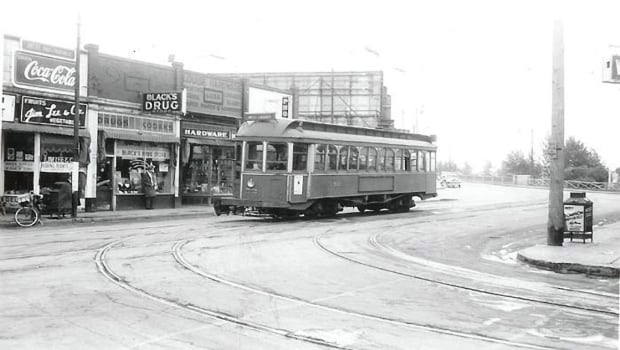
A streetcar travelling north along 10th Street N.W. in Hillhurst-Sunnyside. (Calgary Transit) "The street railway made commercial enterprises feasible beyond the city centre," notes historian Max Foran in his 1978 book, Calgary: An Illustrated History. Transit access and lower rents created the conditions for commercial strips to develop along 17th Ave. S.W., Kensington Road and 10th St. N.W., 4th St. N.W. in Crescent Heights, as well as Edmonton Trail and 1st Ave. N.E. in Bridgeland-Riverside. In the southeast part of Calgary, 8th St. S.E. in Ramsay took off as well as 11th St. S.E. in Alyth-Bonnybrook. To be fair, not all transit development back then was intended to create the urban experience. Streetcars serving Killarney, South Calgary, and Tuxedo Park were primarily used as a way to move people in and out of the core, or across town to their places of work — much like today's C-Train. Creating desirable communitiesNewspaper reports of the time spoke pleasingly of these areas now served by a transit system — with their mix of residential and retail.'The rest of Calgary could go on strike … without disturbing the life of this self-contained suburb.' Calgary Herald, 1919 Here's an excerpt from a story that appeared in the Calgary Herald in 1919. "Hillhurst is truly a city within itself," reads the Herald story. "It is the boast of its residents that the rest of Calgary could go on strike and remain out indefinitely without disturbing the life of this self-contained suburb." Or check out this 1931 newspaper feature on 4th Street S.W. in Cliff Bungalow-Mission. "To the citizen, his home is the centre of a vast circle," wrote the Calgary Daily Herald scribe, "and yet, within that circle he wants to obtain all the modern conveniences without traveling any great distance." The writer described a district of fine homes, plentiful trees, and services ranging from a cake shop to a trunk maker. TOD can do the same todayFast forward to this century.Here's how the City of Calgary describes a TOD on its website; "attractive, urban, walkable environment where there are opportunities to live, work, shop, and play without primarily depending on the automobile." The eras are different but the theme is the same. Residential and retail coupled with accessible public transit create the conditions for a great urban vibe. We know TOD has its critics, chiefly those who dread congestion and the transformation of the neighbourhood they thought they had moved into. Fair enough. But urban sprawl must know its limits, and high-density developments will prevail on the ground and in the hearts of those who live in and near them. 
Kensington is a busy hub of activity. The Sunnyside LRT station is within walking distance. (Neil Zeller) Think back to Sunnyside's resistance to the LRT in the early 1980s, which was overcome through community consultation and input into a compatible station design. Even the streetcar met resistance in the 1930s from Mount Royal residents, who shot down a streetcar line but accepted Calgary's first public bus route as a compromise solution. Community consultation is at the core of TOD. Today's challengesCalgary city councillor Gian-Carlo Carra, himself an urban planner, sees a larger parallel to the streetcar's impact on city development.
Coun. Gian-Carlo Carra sits on the City's Regional Transportation Steering Committee. (CBC) "Basically, the same way the Canadian Pacific Railway built Canada at a continental scale, streetcars built our most beloved neighbourhoods at the scale of the city." Carra worried that the current city council would only view LRT lines as a way to move commuters in and out of the downtown twice a day — and not as an instrument to build great neighbourhoods. But, as planning begins for the north-south Green Line, he is encouraged by council's unqualified support for TOD along the route. "Perhaps what has most galvanized this council to really start pushing TOD as the solution to Calgary's future is the fairly negative proposition that if the next million Calgarians drive as much as the current million, we're doomed." Choice of futuresMy mother grew up in Victoria Park, and her parents never owned an automobile. She raised me in a two-car household in Kingsland, which in the 1970s was considered far from the city centre.Today, I could move twice as far out and still not see the edge of town. We've been programmed to believe in boundless growth, but sooner or later we have to admit that it was folly. 
Calgary is set for a major expansion of its C-Train system with a new north-south line and new LRT stations along the route. (Calgary Transit) Good planning and policy can ease the transition that must come, and it will result in the kind of high-density, transit-based model that TODs offer. Some will see it negatively, as an attack on freedom or a deflation of expectations. History shows us that it really won't be so bad. I think it will be an improvement. Perhaps, one day in the future, someone will ask me to go shopping and do lunch — not in Kensington — but at Anderson. |