

Hillary Clinton wins 4 states, Donald Trump sweeps all 5
原始发布日期: 2016-04-26 发布者:李方字变大 字变小
Trump declares himself 'presumptive nominee,' but still short of required delegates
Democratic presidential hopeful Hillary Clinton has turned her attention to Republican front-runner Donald Trump. (Justin Sullivan, Jessica Kourkounis/Getty Images) 
What is the 'Acela primary'? 1:24 What is the 'Acela primary'? 1:24 In a front-runner's rout, Republican Donald Trump roared to victory Tuesday in five contests across the Northeast, keeping the billionaire firmly on his narrow path to the Republican nomination. Hillary Clinton was dominant in four Democratic races, ceding only Rhode Island to rival Bernie Sanders. Trump's and Clinton's wins propelled them ever closer to a general election showdown. Still, Sanders, as well as Republicans Ted Cruz and John Kasich, have vowed to keep running, even as opportunities to topple the leaders dwindle. "I consider myself the presumptive nominee," Trump declared at his victory rally in the lobby of Trump Tower in New York, despite still being short of the delegates needed to secure the Republican nomination. Clinton expanded her sizable delegate lead over Sanders. Already, Clinton can lose every remaining primary by a wide margin and still capture her party's nomination, according to an Associated Press analysis. Though she did not sweep, her wins put Sanders in a deeper hole — going into Tuesday, he had to win 73 per cent of remaining delegates. "We will unify our party to win this election and build an America where we can all rise together," Clinton declared during a victory rally in Philadelphia, the city where Democrats will gather for their national convention in July. Sanders said in an interview with The Associated Press that his campaign has a "very narrow path" to the nomination despite losses in Pennsylvania, Maryland, Delaware and Connecticut. He said California's primary in June is "very important to us" and he thinks every voter should have "the right to vote for whom they want to see as president of the United States." Even though his campaign is trailing Hillary Clinton, Sanders said "we are going to fight for every delegate" to the Democratic convention to influence the party's agenda. Sanders noted that he won in Rhode Island, which was the only state in Tuesday's contests that allowed independents to participate in the Democratic primary. He said independents will be important in the fall election and superdelegates should take that into consideration. 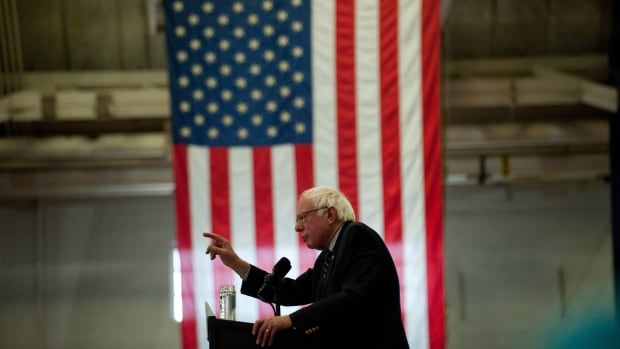
Democratic presidential candidate Bernie Sanders speaks during a rally at University of Pittsburgh Monday. A recent poll suggests four in 10 Sanders supporters may not vote for Clinton. (Jeff Swensen/Getty Images) Clinton earlier turned her attention to the Republican front-runners: Trump and Ted Cruz. Before cheering supporters in Youngwood, Pa., on Monday Clinton said that economic prosperity declined after her husband left the presidency, because "we got a Republican president with a different economic philosophy, back to trickle-down economics, cutting taxes on the wealthy. That did not work, it cannot work and that is what Donald Trump and Ted Cruz are promising to do again." She's also taking steps to try and unify a fractious Democratic party. On Monday, she released a new ad entitled "love and kindness" asking voters to "stand together." It won't be an easy task: A USA Today/Suffolk University poll released this week found that four in 10 Sanders supporters said they weren't sure if they would vote for Clinton. Another 13 per cent said they would vote for Trump over Clinton. Clinton commends Sanders0:40 Sanders is not committing to easing Clinton's path. On MSNBC Tuesday, he said what Clinton "has to do and any candidate has to do is convince the vast majority of the people ... that she is on their side." Entering the primaries, Clinton had a sizeable pledged delegates leads accrued from primaries and caucuses, with 1,428 compared to 1,153 for Sanders. When superdelegates — Democratic party insiders who can back the candidate of their choice regardless of how their state votes — are included, Clinton had 1,946 and Sanders 1,192. It takes 2,383 to win the Democratic nomination, and there were 384 up for grabs Tuesday. Trump wins, rivals renew anti-Trump pushTrump will win at least half of the 118 delegates up for grabs in Tuesday's contests. And he has a chance to win a lot more.In Pennsylvania, Trump collected 17 delegates for winning the state. An additional 54 delegates are elected directly by voters — three in each congressional district. However, their names are listed on the ballot with no information about which presidential candidate they support. Republican Texas Senator Ted Cruz and Ohio Gov. John Kasich are now joining forces to try to stop a Trump nomination. Their loose alliance marks a stunning shift in particular for Cruz, who has called on Kasich to drop out of the race and has confidently touted the strength of his convention strategy. 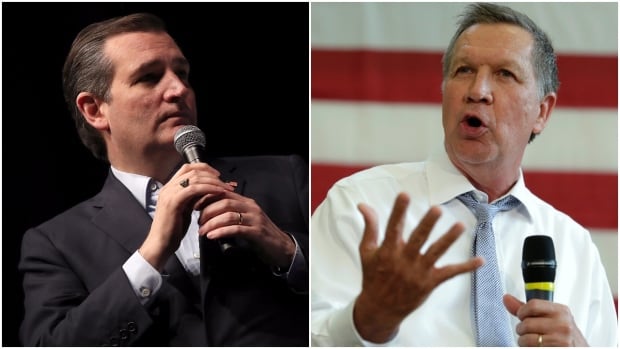
Trump has called the momentary alliance between Cruz, left, and Kasich 'pathetic.' (Win McNamee, Yuri Gripas/AFP/Getty Images) Kasich has won just a single primary — his home state — but hopes to sway convention delegates that he's the only Republican capable of defeating Clinton in the general election. Under their new arrangement, Kasich won't compete for votes in Indiana, allowing Cruz to take Trump on head to head in the state's May 3 primary. Cruz will do the same for Kasich in Oregon and New Mexico. Trump panned his rivals' strategy as "pathetic." "If you collude in business, or if you collude in the stock market, they put you in jail," Trump said as he campaigned in Rhode Island. "But in politics, because it's a rigged system, because it's a corrupt enterprise, in politics you're allowed to collude." America votes: Can Cruz stop Trump?10:51 Cruz and Kasich's public admission of direct coordination was highly unusual and underscored the limited options they now have for stopping the real estate mogul. The effectiveness of the strategy was quickly called into question after Kasich said publicly that while he won't spend resources in Indiana, his supporters in the state should still vote for him. Trump's path to the nomination remains narrow. Going into Tuesday, he needed to win 58 per cent of the remaining delegates to reach the magic number by the end of the primaries. The Associated Press, 2016  |
